 |
 |
 |
|
        |
|||
 |
|||
 |
 |
WinRrich attend Paperwolrd 2014
on this largest wolrd stationery exhibition Winrich will show its all New 2014 products for buyers. Our booth is 4.1 Hall 19
  |
 |
 |
|||
|
New 2014 products catalogue is online active now
difficult to find new products idea? whyn't to view Winrich 2014 products catalogue
 |
||
|
|||
|
Meet Winrich on Creativeworld 2014..
for all buyers , meet us on Frankfurt, 30 January - 2 February, 2014
 |
||
|
|||
|
Value added service... is to realize a service platform with all the projects, not only the products, but also...
 |
||
|
|||
|
Winrich iCommunication coming soon...online communication with us for tracking your orders in 24 hours, forget any timedefferency...
 |
||
|
|||
|
||||
 |
||||

|
||||
|
|
||||
Winrich is acknowledged as the Chinese masters in the making of artists' pastels - and to complement the range of almost 200 tints, there are specialist surfaces and fixatives. The finest pigments are blended with chalk and china clay to produce the vibrant colour and smooth velvet texture of Artists' Soft Pastels, each one carefully wrapped by hand. For more detailed line work, Artists' Square Pastels are a little firmer to create a harder mark. Oil Pastels, which require no fixing, are a versatile and economical medium for drawing and painting, used on their own or in mixed media work. |
||||
| Hard Pastels | Soft Pastels | Oil Pastels | ||
 |
 |
 |
||
Each carefully prepared blend of pure pigments gives a clean velvety mark allowing for better coverage. The ingredients are carefully examined to give brilliant colour while maintaining a square edge for fine strokes. Winrich Hard Pastels are formulated to unsurpassed levels of lightfastness. There are 36 colors in the range and these are available in sets of earth colours, and in a set of greys & blacks. |
Over many decades Winrich have perfected the art of soft pastel making. The finest available pigments are combined with other ingredients to give the smoothest and most consistent painting experience through a carefully balanced range of 94 tints. The softness of each pastel enables the production of rich graduated velvet tones of unsurpassed richness and hue. |
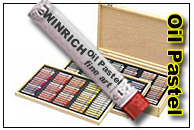
A serious painting medium, they provide both an oil and a pastel effect and do not require fixing. These artist quality Oil Pastels were originally developed by Winrich. They are made with carefully selected mineral and organic pigments, mixed with a specially formulated non-drying binder, and combined with the finest quality wax.They have been refined and introduced in this liberating new big size. 100 colors are exquisitely presented in a wooden box. Each color is made with pure pigments for maximum lightfastness, brilliance, color intensity, and opacity. |
||
 About pastels About pastels |
||||
Pastel is an art medium in the form of a stick, consisting of pure powdered pigment and a binder. The pigments used in pastels are the same as those used to produce all colored art media, including oil paints. Dry pastels have historically used binders such as gum arabic, gum tragacanth. Methyl cellulose was introduced as a binder in the twentieth century. Often a chalk or gypsum component is present. They are available in varying degrees of hardness, the softer varieties being wrapped in paper. Dry pastel media can be subdivided as follows: Soft pastels — This is the most widely used form of pastel. The sticks have a higher portion of pigment and less binder, resulting in brighter colors. The drawing can be readily smudged and blended, but it results in a higher proportion of dust. Drawings made with soft pastels require a fixative to prevent smudging. Hard pastels — These have a higher portion of binder and less pigment, producing a sharp drawing material that is useful for fine details. These can be used with other pastels for drawing outlines and adding accents. However the colors are less brilliant than with, say, soft pastels. Pastel pencils — These are pencils with a pastel lead. They are useful for adding fine details. In addition, pastels using a different approach to manufacture have been developed: Oil pastels — These have a soft, buttery consistency and intense colors. They are slightly more difficult to blend than soft pastels, but do not require a fixative. (See separate section on oil pastel for more details) Water-soluble pastels — These are similar to soft pastels, but contain a water-soluble component, such as glycol. This allows the colors to be thinned out using a water wash. |
||||


 |

 Copyright 2003, WinRichStationery.com Copyright 2003, WinRichStationery.com |
Home|Site map|About us|Products|Services|Jobs|World|Contact us |
